Looking forward to an exciting new year!
![]() |

Looking forward to an exciting new year!

More than two thousand years ago, the Hippocratic Corpus (5th century BCE) fostered principles of beneficence, non-maleficence, confidentiality, and accountability to help guide physician practices and behaviors. These ideals were later embraced by Christian, Jewish, and Islamic ethical traditions from the Middle Ages through the Enlightenment. In 7th century China, Sun Simiao emphasized compassion, selfless dedication, and duty in his important work, On the Absolute Sincerity of Great Physicians, while Buddhist traditions, coexisting with ancient Confucianism, valued generosity (dāna) and the precept of non-injury. Across cultures and eras, medical ethics has thus joined duty with virtue, blending obligation and character to help define good medical practice.
In contemporary healthcare ethics, beneficence is described as actions and rules aimed at benefiting others, helping them further their legitimate interests and preventing or removing potential harms. It is usually viewed as a moral obligation or duty rooted in professional responsibility. It defines what one ought to do in a particular situation, whether to improve patient welfare, protect life, or pursue specifically desired health-related outcomes.
Benevolence, by contrast, describes a disposition, not an obligation. The Oxford Dictionary of Philosophy defines it as the “general desire for the good of others, and a disposition to act so as to further that good.” While benevolence derives from the principle of beneficence, it is a moral virtue equated with charity, kindness, and generosity. As such, it can be distinguished from beneficence in that it is grounded in goodwill toward patients rather than in professional duty. While beneficence concerns right action, benevolence concerns right intention—and the two, though often aligned, are not identical.
This distinction becomes evident in clinical practice. For example, a physician may act beneficently toward a patient because of their sense of duty, even when the patient is abusive, dangerous, or requesting medical aid in situations that conflict with the physician’s personal values. In such cases, a doctor’s intrinsic desire “to do good” for their patient may be lacking, yet they may still act rightly and in accordance with professional standards.
Benevolence, however, explains actions of a different type. Grounded in the humanity of health care providers, it reflects a physician’s disposition toward goodwill rather than obligation. It may motivate behaviors that are ultimately detrimental to a patient’s well-being when unchecked by professional or ethical norms. It may also explain why some providers undertake actions that are heroic or go beyond those required by duty. In the extreme, these may involve extraordinary personal sacrifice to aid vulnerable patients.
In the end, the practice of medicine is judged not only by outcomes and rules, but by intention. Beneficence may compel right action in the right circumstances, while benevolence often reveals the moral character—the right reasons—from which care emerges. Together, they affirm essential moral dimensions of ethical medical practice.

More than two thousand years ago, the Hippocratic Corpus (5th century BCE) fostered principles of beneficence, non-maleficence, confidentiality, and accountability to help guide physician practices and behaviors. These ideals were later embraced by Christian, Jewish, and Islamic ethical traditions from the Middle Ages through the Enlightenment. In 7th century China, Sun Simiao emphasized compassion, selfless dedication, and duty in his important work, On the Absolute Sincerity of Great Physicians, while Buddhist traditions, coexisting with ancient Confucianism, valued generosity (dāna) and the precept of non-injury. Across cultures and eras, medical ethics has thus joined duty with virtue, blending obligation and character to help define good medical practice.
In contemporary healthcare ethics, beneficence is described as actions and rules aimed at benefiting others, helping them further their legitimate interests and preventing or removing potential harms. It is usually viewed as a moral obligation or duty rooted in professional responsibility. It defines what one ought to do in a particular situation, whether to improve patient welfare, protect life, or pursue specifically desired health-related outcomes.
Benevolence, by contrast, describes a disposition, not an obligation. The Oxford Dictionary of Philosophy defines it as the “general desire for the good of others, and a disposition to act so as to further that good.” While benevolence derives from the principle of beneficence, it is a moral virtue equated with charity, kindness, and generosity. As such, it can be distinguished from beneficence in that it is grounded in goodwill toward patients rather than in professional duty. While beneficence concerns right action, benevolence concerns right intention—and the two, though often aligned, are not identical.
This distinction becomes evident in clinical practice. For example, a physician may act beneficently toward a patient because of their sense of duty, even when the patient is abusive, dangerous, or requesting medical aid in situations that conflict with the physician’s personal values. In such cases, a doctor’s intrinsic desire “to do good” for their patient may be lacking, yet they may still act rightly and in accordance with professional standards.
Benevolence, however, explains actions of a different type. Grounded in the humanity of health care providers, it reflects a physician’s disposition toward goodwill rather than obligation. It may motivate behaviors that are ultimately detrimental to a patient’s well-being when unchecked by professional or ethical norms. It may also explain why some providers undertake actions that are heroic or go beyond those required by duty. In the extreme, these may involve extraordinary personal sacrifice to aid vulnerable patients.
In the end, the practice of medicine is judged not only by outcomes and rules, but by intention. Beneficence may compel right action in the right circumstances, while benevolence often reveals the moral character—the right reasons—from which care emerges. Together, they affirm essential moral dimensions of ethical medical practice.

HIV/AIDS is now manageable, yet millions of people still lack access to care. The world commemorates December 1 as World AIDS Day, a date observed since 1988 to remind us that HIV/AIDS remains a major global health challenge. Today, more than 40 million people are living with HIV worldwide, the majority in sub-Saharan Africa. Thanks to antiretroviral therapy and improved treatment of opportunistic infections, deaths from HIV/AIDS have fallen by more than fifty percent since 2010, and HIV can now be considered a chronic, manageable health condition.
Transmission of HIV continues, however. More than one million new infections occurred in 2024, with particularly high rates among young women in Africa. Moreover, according to the World Health Organization, only 87 percent of people living with HIV know their status, and nearly one quarter are not receiving antiretroviral therapy.
Yet political commitment has not translated into equitable access. In 2015, United Nations world leaders unanimously pledged to end the AIDS epidemic by 2030. According to UNAIDS, the world is not on track to meet that goal. Progress has been hampered by breaks in solidarity between and within countries. Advances in long-acting treatment and prevention technologies are not being adequately shared with all low- and middle-income nations, and many HIV programs continue to overlook people from key populations. These include sex workers; gay men and other men who have sex with men; people who inject drugs; transgender people; and people who are incarcerated or detained in closed settings. At the same time, rising infection rates are being reported in eastern Europe and central Asia, Latin America, and the Middle East and North Africa.
Although access to HIV treatment continues to expand, prevention and education programs have suffered from chronic underfunding. Household surveys suggest that condom use has declined in recent years, particularly among young people aged 15-24 and among those engaging in sex with non-regular partners. In many countries, community-led organizations are also struggling to survive financially, especially those addressing HIV alongside broader human rights concerns, including the right to universal health care.
Given that millions of people continue to live with HIV infection and HIV-related disease, HIV/AIDS remains a serious threat to public health. Continued progress in prevention, diagnosis, and treatment is essential, but at least three additional challenges demand attention. First, stigma and discrimination must still be eliminated in many regions. Second, the aging population of people living with HIV requires health systems capable of managing patients with chronic comorbidities such as hypertension, diabetes, and cancer. Finally, health care providers and community educators must not overlook the ongoing risk of HIV transmission among older adults.
The awareness ribbon reminds us that awareness without action is insufficient. The never- trademarked Red Ribbon was chosen as the international symbol of AIDS awareness by the Visual AIDS Artists Caucus in 1991 and was first worn by actor Jeremy Irons at that year’s Tony Awards. The ribbon symbolizes love and compassion for those people living with HIV/AIDS, blood in recognition of transmission, and urgency—a signal that the work of prevention, solidarity, and care remains unfinished.

In her book, On Revolution, German-American political thinker and philosopher Hannah Arendt (1906-1975) wrote that a revolutionary spirit is not defined as the action of a people, but as a set of political principles characterized by concomitant ideas of freedom and the experience of a new beginning. For medical educators, the concept of the democratization of knowledge, associated with the proliferation of computers and web-based learning, interactive information systems, and greater access to virtual reality and computer simulation, embodies such a revolutionary spirit.
This is because the widespread dissemination of educational systems dedicated to the health care environment is the exact opposite of the antiquated practice of coerced acceptance of information through conventional power structures in the ivory towers of academia. The older system was often based on academic hierarchies and teachers who, as both owners and retainers of knowledge, had power over learners. The newer system, however, is built on the give-and-take of democratization, with virtually instantaneous, open access to information enabled by affordable technological advances. These include but are not limited to critical analyses of that information through podcasts and interviews, open access rather than fire-walled peer-reviewed scientific literature, and thousands of lectures or commentaries on YouTube and other social media sites.
Arendt also wrote that revolution implies a change radical enough to be experienced as an entirely new beginning. It signifies more than a change, which, as Arendt says, can be cyclical (as in change from one form of government to another; a monarchy might become an oligarchy, an oligarchy might become a democracy, and so on). A revolution is also not to be confused with rebellion, which might substitute one form of leadership, or one prevailing paradigm, for another. Nor is revolution, in its social and political sense, a restoration to what once was. In other words, it is not represented by coming full circle back to a preordained order.
Instead, a revolution, according to Arendt, signifies a new beginning, not only in social thought but also regarding actions inspired by a “revolutionary spirit.” In his brilliant new series titled The American Revolution, documentary filmmaker Ken Burns illustrates how the American colonies’ revolt against Great Britain was inspired by such a spirit fueled by the novel idea that all men had inalienable political rights by birth. Of course, there were shortcomings to the founding fathers’ implementation of this idea, for sadly, it would take many years before such “rights” would be extended to indigenous populations, enslaved people, and women.
But the purpose of this essay is not to expound on the concept of revolution, but to reflect on whether medical education today represents the dawn of a new beginning marked by digital democratization and driven by the revolutionary spirit. I believe it is, although with some caveats.
Technology allows for information, ideas, and images to transcend national boundaries. Still, healthcare professionals benefit greatly when they personally identify with physical role models and engage in the intricacies of the human experience gained through direct, face-to-face interactions with their patients. Just as a teacher’s actions and behaviors influence their students’ manners and performances at the bedside, for example, a patient’s feelings and behaviors can equally affect the ultimate quality of a physician’s professional attitudes and demeanor.
We must not forget, therefore, that health care delivery entails the delivery of healthcare, which is, after all, a human service profession. Learning to care for the sick, the injured, and the fatally ill with demonstrable empathy and compassion is not easily mastered through books and modern technology alone. The revolutionary spirit might spark our embrace of new technologies and educational systems but carries in its mist all that is valuable and sacred about the physician-patient encounter.

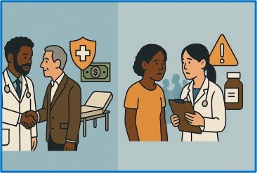
California’s health care system is increasingly divided between two contrasting health care business systems. These are high-cost concierge medicine and the essential safety net of Medi-Cal. This growing split is shaping health care experiences across the state. It is not surprising, therefore, that many of my friends and acquaintances have been complaining about their health care recently.
Escalating costs, decreased face time with their physicians, obviously hurrying nurses and administrative staff, and difficulties scheduling tests and follow-up appointments are commonly discussed over coffee. Stories of bad experiences seem to abound. One was about a doctor saying they could move their patient through the system faster if they signed up for her ‘concierge services.’ Another was about a subspecialist who didn’t introduce themselves to new patients at a busy neighborhood public health clinic.
This got me thinking again about two aspects of the health care business in the United States, particularly in California, which has a population of almost 40 million. The first is known as Concierge medicine. In these practices, physicians charge substantial monthly or annual retainers, sometimes reaching as high as $20,000 per year.
These services promise faster access, longer visits, and more personalized care. Some concierge practices bill insurance companies, especially for specialty services, lab tests, procedures, and imaging studies. Others, mainly in the realm of direct primary care (DPC), might not bill third-party insurers for some things. Patients pay either through their retainer or directly using a lower fee-for-service model.
Today, concierge services are provided by about 2% of U.S. physicians, but they are growing rapidly. Some studies show that these services reduce emergency department use and improve patient and physician satisfaction. One recent study showed that California, with its many wealth-concentrated urban and suburban neighborhoods, has the highest concentration and growth rate of concierge practices in the United States. Perhaps this is why people refer to them as “boutique” or “VIP” medicine.
A second aspect of the health care business is Medi-Cal, California’s Medicaid program that provides health insurance to low-income individuals and families. Eligibility is linked to the Federal Poverty Level. This corresponds to about fifteen million people, more than one-third of the state’s residents. According to the California Health Care Foundation, this means 3 in 7 children, 2 in 9 non-elderly adults, and 2 in 5 people with disabilities. It also includes 1.5 million Californians aged 65 and older (about 25% of the 6 million seniors living in California).
My own experience caring for patients with Medi-Cal coverage was, for the most part, nontraumatic. Perhaps this is because my department was in an academic center of the University of California, which did not distinguish between types of insurance. My team considered all our patients VIPs, regardless of insurance status, race, nationality, gender, social position, financial situation, sexual orientation, or education. For this, I am both grateful and proud.
Some criticisms of the Medi-Cal system, however, are long waits for appointments, the high administrative burdens of enrollment and eligibility, and patients feeling discriminated against because of cultural sensitivities, language barriers, and the stigma of their Medi-Cal status and financial conditions.
Thinking about these two contrasting health care business systems reminds me of the complexity of the health care delivery process. It makes me thankful that most of the health care providers I have known, from world-famous surgeons to newly hired and still inexperienced administrative assistants, remained true to their calling: to treat every patient equally, with respect, consideration, and the same level of care regardless of their circumstances.

Betrayal occupies a unique space in the human experience, as anyone who has felt betrayed knows all too well. In the healthcare environment, it represents one of the most ethically charged and psychologically damaging forms of a relational breakdown. From this perspective, it is very different from romantic betrayal or interpersonal treachery. It is a breach of trust and responsibility, a sorry manifestation of the power imbalance that exists between physicians and their patients. In this first of several short essays on the subject, I address the silent wounds of medical betrayal on the perpetrators themselves.
Medical care is both highly technical and grounded in an often obscure and changing clinical science. While most physicians do what they believe is in their patients’ best interests, some jeopardize their personal and professional integrity to comply with institutional guidelines, a mentor’s instructions, financial obligations, political positions, or their perceived need to embrace technological advances before supporting scientific evidence is established.
Knowingly providing suboptimal medical care, failing to disclose conflicts of interest, or making misleading statements or false promises are just a few ways physicians betray their patients’ trust. But there are others. Alfred Tauber, author of Confessions of a Medical Man, for example, wrote of the dangers of the physician-technocrat who turns medical care into a business transaction, and Oliver Sacks, in A Leg to Stand On, described the devastating emotional impact on patients who feel abandoned by their caregivers.
When doctors nonchalantly neglect a patient’s humanity, however, they do more than a disservice to their profession and their patients. An act of betrayal shatters the moral basis of professional obligation, the ethical foundation that resides in a fiduciary trust built on a patient’s vulnerability and the physician’s promise of beneficence. For the perpetrator (is that too strong a word?) professional burnout, cynicism, and a growing sense of personal failure can ensue, with long-term effects on a health care provider’s mental health.
The emotional consequences for the instigator of such betrayals, whether the betrayal is of a patient or of the ethical obligations of the profession, are what psychologists call self-inflicted moral injuries. Shame and guilt, self-disgust, emotional exhaustion, and detachment from colleagues and patients can lead to increased feelings of anxiety or depression, substance abuse, and sleep disruption. Over time, these and others may lead to developing a distorted sense of professional obligations, poor performance, and loss of credibility.
The effects of self-inflicted moral injury on one’s sense of meaning, purpose, and personal identity can be devastating. They may lead to abandoning the health care profession, and in worst case scenarios, to excessive drug and alcohol consumption, disruption of the nuclear family, and even suicide.
Committing an act of medical betrayal causes a silent wound that easily grows over time. The old adage, to forgive and forget, does not readily apply, and often, this wound requires professional help to heal.

November is Lung Cancer Awareness Month, and with it, renewed interest in what is still the most diagnosed cancer in the world when both sexes are combined. Recent statistics show that about 2.5 million new cases are discovered each year, representing one in eight cancers worldwide (12%).
In the United States, lung cancer accounts for about 11% of all new cancer diagnoses (about 227,000 cases per year). While most lung cancers are attributed to smoking, the disease also strikes an increasing number of people who never smoked (20,000-40,000 cases per year).
One alarming statistic is that among never-smokers (defined as having smoked less than 100 cigarettes), females had a 54% higher risk for developing lung cancer compared to their male counterparts. Dr. Narjust Florez of the Dana-Farber Cancer Institute said that “Younger women take three times as long to be diagnosed compared with younger men – even when you match for age, risk factors, and geography.”
Studies show that secondhand (environmental) tobacco smoke, outdoor and indoor air pollution, and genetic susceptibility (family history and genomic variants such as EGFR mutations and ALK gene rearrangements) are risk factors for lung cancer in non/never-smokers. These represent 15-20% of all lung cancers worldwide!
According to the American Lung Association, less than a third of lung cancers are diagnosed at an early stage. Progression is often silent, and by the time symptoms such as cough, chest discomfort, or shortness of breath are taken seriously by patients and health care professionals, the disease has often progressed. Not surprisingly, it has one of the lowest five-year survival rates of all cancers and remains the leading cause of cancer death worldwide.
All of the above are reasons enough to increase the public’s awareness of lung cancer.
If we are to combat lung cancer effectively, November and every month should be lung cancer awareness month. It is crucial for all health care providers to recognize the dangers of this disease and the need for people at risk to enroll in newly developing lung cancer screening programs. Both specialists and primary care providers should never neglect the possibility of lung cancer in non-smokers, including in men and women under the age of sixty-five. I have heard too many stories about doctors who ignored what turned out to be early symptoms of the disease or neglected to follow up with someone at low or no risk, whose cough transiently disappeared enough for them to avoid seeking more medical attention.
From a philosophical standpoint, awareness involves more than information processing. It is a character of our consciousness. To become “aware” means to experience something and to consciously recognize what we are doing, feeling, and thinking in the present moment. The menace of lung cancer is real, and like many illnesses, threatens us all.
Let’s be AWARE of that and do something about it.

Since its official proclamation as a national holiday by President Abraham Lincoln in 1863, Thanksgiving is a day when many North American families and friends come together to share a meal, focus on their sense of giving and community, and express their gratitude for life’s gifts and blessings. The tradition may have started with the Green Corn Dance of the Cherokee Indians, or with a feast held by Europeans who arrived in Newfoundland in 1578. However, most schoolchildren today associate this holiday with a meal more than four hundred years ago, when in 1621, almost one hundred members of the Native American Wampanoag tribe shared the fruits of an autumn harvest with a small group of English settlers in Plymouth, Massachusetts.
Sadly, this celebration of peaceful camaraderie between Native Americans and colonists was followed by the spread of infectious disease and violence that decimated much of the indigenous population. Still, the idea of proclaiming days of thanksgiving took hold, first in New England, and later throughout the territories that became the United States of America. On the 27th of this month, therefore, like every year on the fourth Thursday of November, people will gather from around the country to give thanks.
But, I wonder, doesn’t each and every day provide endless opportunities for thanks-giving?
Gratitude, defined as feelings of thankfulness, acts of showing appreciation, or as a duty to repay or acknowledge gestures of kindness, occupies an important place in human thought, feelings, and social interactions. While philosophers may debate its affective, cognitive, communicative, and conative elements, sociologists describe how expressions of gratitude validate the feelings and behaviors of others and help shape cultural practices and social solidarity. The danger is that gratitude might easily be seen as a burden or obligation. To this, Lebanese writer Khalil Gibran answered, “And you receivers—and you are all receivers—assume no weight of gratitude, lest you lay a yoke upon yourself and upon him who gives. Rather rise together with the giver on his gifts as on wings…” For Gibran, gratitude is an expression of humility. Far more than a transaction, it is a manifestation of the art of receiving and giving that forms a cornerstone of life itself.

Three other philosophers and I recently devoted eight hours of Socratic Dialogue to the topic of resilience. Using this method, participants blend philosophical inquiry with personal experience in a search for truth. Our goal was to define resilience, not from somewhere “outside” ourselves (i.e., from books, teachings, etc.), but from within, based solely on the lived experience of one of the participants.
Our “dialogue” differed from a “discussion” in that we spent our time investigating (rather than convincing), listening to ourselves and each other (rather than taking positions), and questioning (rather than answering) in order to come up with a definition that might apply to virtually all persons regardless of circumstances (before starting, we chose to focus solely on modern humans/Homo sapiens).
Our collective inquiry concluded that resilience is the manifestation of positive adaptation resulting in personal growth in an adverse situation. To this, we added the stipulation that resilience is a process that implies decision making (a cognitive means by which one chooses to believe, act, or feel from among possible alternatives) and flexibility of mind (the ability to adapt one’s thoughts, emotions, and behaviors to changing situations).
I have since been thinking about how this definition applies to health care providers. Medicine is an emotionally and cognitively demanding profession. Sometimes it is also physically exhausting. There are strenuous work schedules, long hours, ethical dilemmas, and pressures from working with scientific uncertainty. There are legal considerations, the burdens of teamwork and an occasional forced collegiality, as well as the reality of medical and surgical errors. Workplace-related political traumas, bureaucratic overload, interprofessional drama, and the burdens of complex decision-making are not easily overcome. With the addition of repeated exposures to human suffering and loss, particularly in the absence of adequate support from family, friends, colleagues, or institutions, a health care provider’s emotional, mental, and psychological states are prone to dysfunctionality.
Burnout, for example, touches almost half of all physicians in the United States. This affects patient outcomes, institutional efficiency, professional longevity, and overall well-being. Several studies show that physicians are at greater risk of burnout (characterized by symptoms of distress and dissociation) and have lower satisfaction with work-life integration than the general population, after controlling for age, sex, relationship status, and hours worked per week.
Resilience, manifested as positive adaptation in the face of significant adversity, is more than showing grit or being emotionally “tough.” According to our group’s definition, it is also a potentially life-changing or “perspective-altering” phenomenon closely linked to personal growth and self-awareness. It is, therefore, both intrapersonal and relational. It allows health care providers to engage deeply with patients and those around them without being consumed by adverse situations. It supports cognitive clarity under pressure and demonstrates the ability to experience distress without becoming dysfunctional, while maintaining the capacity to reframe adverse situations in ways that engender positive feelings, actions, and thoughts.