Tag Archives: Education

Communication in Health Care: Patients and Providers

Effective communication in healthcare

 Communication in health care relies on a foundation of trust and psychological safety amid unexamined assumptions, non-dits (which is French for things left unsaid), potentially mismatched expectations, asymmetries of knowledge and power, vulnerability, unspoken emotional defenses, and differences in understanding or health care literacy. Perhaps this is why effective communication requires more than clarity of language. It also requires our attention to meaning, context, and subjective experiences, including the “emotional baggage” carried by all those involved in our conversations.

Whenever we communicate, we receive, transmit, and interpret both information and feelings. Psychological research shows that effective communication in health care is tied to perceived empathy, narrative coherence, and opportunities for all involved parties to be heard. Taking the time to sit at the patient’s bedside and avoiding potential distractions such as phone calls, computer screens, or unnecessary interruptions can be key to establishing rapport. In my experience, providers operating under time constraints, emotional strain, or institutional pressures have difficulty recognizing how fear, hope, and struggles tackling ambiguity or uncertainty adversely affect their patients’ understanding. They risk using technical jargon, matter-of-fact approaches, or paternalistic attitudes to rush through a conversation, disregard differences in health care literacy, or achieve a specific desired outcome. Hence, health care providers might subconsciously or intentionally distance themselves emotionally from their patients. The result is a potential undermining of a patient’s trust. Consequently, both caring and compassion are sacrificed on the altar of efficiency.  

Interprofessional communication between physicians, nurses, technicians, and allied health professionals also has its challenges. Healthy dialogue means overcoming real and perceived hierarchical barriers and role ambiguities. It means negotiating intergenerational differences, acknowledging differing professional identities grounded in diverse yet strangely singular training paradigms, and recognizing inward disengagement even when outward appearances signal agreement or a willingness to comply.

Overall, this introduces yet another layer of complexity to effective communication. Cultural expectations can vary significantly among trainees, mid-career professionals, and more senior practitioners. Intergenerational differences of opinion might exist regarding what constitutes competence and professionalism, for example, or how to communicate with respect to cultural diversity. Not everyone has similar views on the appropriateness of multitasking (it took me a while to realize that young people can remember and reflect on what I say even while scrolling through pictures and texts on their mobile phones), or on when to rely on narrative versus factual reasoning. 

Much more can be said about communication in health care. In future essays, I will briefly address dialogue between health care providers and administrators, conversations with patients’ families, and the challenge of effective communication with staff, other team members, and direct reports. I will also discuss communication failures and why I believe the observation and improvement of communication skills should be an integral part of competency—based training.  

Maleficence in Healthcare

Shows doctors and examples of intentional and unintentional maleficence


Maleficence in healthcare refers to any intentional and unintentional harm caused by healthcare providers or health systems. It is usually discussed in contrast to nonmaleficence, the avoidance of causing harm, one of the pillars of the Four Principles approach to medical ethics proposed by Beauchamp and Childress in the 1970s.

Intentional maleficence manifests as deliberate actions that knowingly harm patients. Thankfully, it is rare, and acts of intentional hurt, deception, exploitation, or fraud are universally frowned upon by health care providers, professional organizations, institutions, and society at large. Any intentional infliction of harm obviously betrays patient trust, which is the foundation of all physician-patient relationships.

Some of the most notorious examples of intentional maleficence stem from authoritarian regimes or times of military conflict. Acts ascribed to Nazi healthcare providers before and during World War II are among those most frequently cited. Forced euthanasia, the deliberate killing of populations considered unworthy of life, forced sterilization programs, and harmful experimentation in the name of science (such as cold-water immersion, intentional injection, or exposure to knowingly toxic substances, etc.) illustrate how Nazi doctors, midwives, nurses, and technicians intentionally murdered, tortured, or abused patients and other victims of the repressive Nazi regime. 

Other flagrant examples of intentional maleficence occurred during Argentina’s brutal military dictatorship (1976-1983). During this time, some health care providers were complicit in the torture or murder of innocent victims detained by state agents. This included documenting false causes of death (such as falls from high places), administering drugs to torture victims, and falsifying records used to facilitate unlawful adoptions of disappeared children. 

Equally disturbing are discoveries made during and after the Second Gulf War (2003-2011). Health care providers pressured by Saddam Hussein’s oppressive Ba’ath regime allegedly falsified death certificates and misrepresented legal reports of torture. Also troubling are reports that psychologists and United States military personnel failed to report human rights abuses of detainees undergoing interrogations at Abu Ghraib and Guantanamo Bay. 

Of course, cases of intentional maleficence are not limited to health care delivery under authoritarian or military regimes. Other examples include unethical human experimentation, the deliberate withholding of treatment (the 40-year Untreated Syphilis Study at Tuskegee comes to mind), performing unnecessary procedures regardless of context, economic misconduct and fraudulent practices to satisfy scientific, personal, or financial ambitions, and ideologically-driven care that disregards patient welfare in favor of personal gain or adherence to doctrinal beliefs and political policies.

*

While intentional maleficence is a clear violation of professional ethics and fiduciary duty, the picture is less clear in cases of unintentional maleficence, which is both more prevalent and ethically complex. Unintentional maleficence usually stems from cognitive and experiential bias, system pressures, fragmented care, miscommunication, a propensity to practice medicine defensively, clinical uncertainty, or unwarranted therapeutic zeal. It can also be an unfortunate and even deadly result of medical error, negligence or professional incompetence.

Unintentional maleficence often occurs despite well-intentioned practices. In these cases, ethical analysis is challenging because health care providers usually act in the pursuit of beneficence. A prime example is any medical intervention for which possibilities for an undesired outcome are underestimated or not revealed. High-risk treatments, polypharmacy in vulnerable populations, and technically correct but ethically damaging decisions are other instances where harm may occur despite a health care provider’s intention to help. A well-known illustration is “the double effect,” in which a medical intervention has two causally independent outcomes: one that is ethically and legally acceptable, such as the relief of pain or anxiety, and another that is not, such as a patient’s death from oversedation.

Maleficence in healthcare includes both intentional and unintentional harm caused by clinicians or systems, raising complex ethical challenges that go beyond nonmaleficence. In my opinion, more conversations about these topics are warranted within the Interventional Pulmonology community. This is because maleficence encompasses both intentional and unintentional harms arising from clinical actions, flawed decision-making, or omission. These may result in ethical violations, poor patient outcomes, and ideological harm. Health care providers, institutions, and professional societies are morally accountable to design systems that minimize foreseeable harm and respond proactively to sentinel events. They should create and support conditions that prioritize patient safety, transparency, overall well-being, and ethical awareness over convenience, personal gain, or professional protectionism.

  • Beauchamp TL and Childress JF (2019). Principles of Biomedical Ethics (8th ed). Oxford University Press.
  • Beecher HK. Ethics and Clinical Research. N Engl J Med 1966;274:1354-1360.
  • Weindling PJ (2004). Nazi Medicine and Nuremberg Trials. Palgrave Macmillan.
  • Reis C, Ahmed AT, Amowitz LL, et al. Physician Participation in Human Rights Abuses in Southern Iraq. JAMA. 2004;291(12):1480–1486. doi:10.1001/jama.291.12.1480.
  • Scheper-Hughes, N. The Ghosts of Montes de Oca: Buried Subtext of Argentina’s Dirty War.” The Americas2015;72(2):187-220. Project MUSEhttps://muse.jhu.edu/article/579738.
  • Newly unredacted report confirms psychologists supported illegal interrogations in Iraq and Afghanistan. ACLU Release, April 30, 2008. https://www.aclu.org/press-releases/newly-unredacted-report-confirms-psychologists-supported-illegal-interrogations-iraq.

Why World AIDS Day Still Matters

Doctor in white coat wearing the Red Ribbon that remains a symbol of awareness, compassion, and the unfinished work of ending AIDS.
Photo courtesy Bermix studio (Unsplash)

HIV/AIDS is now manageable, yet millions of people still lack access to care. The world commemorates December 1 as World AIDS Day, a date observed since 1988 to remind us that HIV/AIDS remains a major global health challenge. Today, more than 40 million people are living with HIV worldwide, the majority in sub-Saharan Africa. Thanks to antiretroviral therapy and improved treatment of opportunistic infections, deaths from HIV/AIDS have fallen by more than fifty percent since 2010, and HIV can now be considered a chronic, manageable health condition. 

Transmission of HIV continues, however. More than one million new infections occurred in 2024, with particularly high rates among young women in Africa. Moreover, according to the World Health Organization, only 87 percent of people living with HIV know their status, and nearly one quarter are not receiving antiretroviral therapy.

Yet political commitment has not translated into equitable access. In 2015, United Nations world leaders unanimously pledged to end the AIDS epidemic by 2030. According to UNAIDS, the world is not on track to meet that goal. Progress has been hampered by breaks in solidarity between and within countries. Advances in long-acting treatment and prevention technologies are not being adequately shared with all low- and middle-income nations, and many HIV programs continue to overlook people from key populations. These include sex workers; gay men and other men who have sex with men; people who inject drugs; transgender people; and people who are incarcerated or detained in closed settings. At the same time, rising infection rates are being reported in eastern Europe and central Asia, Latin America, and the Middle East and North Africa. 

Although access to HIV treatment continues to expand, prevention and education programs have suffered from chronic underfunding. Household surveys suggest that condom use has declined in recent years, particularly among young people aged 15-24 and among those engaging in sex with non-regular partners. In many countries, community-led organizations are also struggling to survive financially, especially those addressing HIV alongside broader human rights concerns, including the right to universal health care.

Given that millions of people continue to live with HIV infection and HIV-related disease, HIV/AIDS remains a serious threat to public health. Continued progress in prevention, diagnosis, and treatment is essential, but at least three additional challenges demand attention. First, stigma and discrimination must still be eliminated in many regions. Second, the aging population of people living with HIV requires health systems capable of managing patients with chronic comorbidities such as hypertension, diabetes, and cancer. Finally, health care providers and community educators must not overlook the ongoing risk of HIV transmission among older adults.

The awareness ribbon reminds us that awareness without action is insufficient. The never- trademarked Red Ribbon was chosen as the international symbol of AIDS awareness by the Visual AIDS Artists Caucus in 1991 and was first worn by actor Jeremy Irons at that year’s Tony Awards. The ribbon symbolizes love and compassion for those people living with HIV/AIDS, blood in recognition of transmission, and urgency—a signal that the work of prevention, solidarity, and care remains unfinished.

Lung Cancer Awareness Month

White ribbon logo for lung cancer awareness month


November is Lung Cancer Awareness Month, and with it, renewed interest in what is still the most diagnosed cancer in the world when both sexes are combined. Recent statistics show that about 2.5 million new cases are discovered each year, representing one in eight cancers worldwide (12%). 

In the United States, lung cancer accounts for about 11% of all new cancer diagnoses (about 227,000 cases per year). While most lung cancers are attributed to smoking, the disease also strikes an increasing number of people who never smoked (20,000-40,000 cases per year). 

One alarming statistic is that among never-smokers (defined as having smoked less than 100 cigarettes), females had a 54% higher risk for developing lung cancer compared to their male counterparts. Dr. Narjust Florez of the Dana-Farber Cancer Institute said that “Younger women take three times as long to be diagnosed compared with younger men – even when you match for age, risk factors, and geography.” 

Studies show that secondhand (environmental) tobacco smoke, outdoor and indoor air pollution, and genetic susceptibility (family history and genomic variants such as EGFR mutations and ALK gene rearrangements) are risk factors for lung cancer in non/never-smokers. These represent 15-20% of all lung cancers worldwide!

According to the American Lung Association, less than a third of lung cancers are diagnosed at an early stage. Progression is often silent, and by the time symptoms such as cough, chest discomfort, or shortness of breath are taken seriously by patients and health care professionals, the disease has often progressed. Not surprisingly, it has one of the lowest five-year survival rates of all cancers and remains the leading cause of cancer death worldwide.

All of the above are reasons enough to increase the public’s awareness of lung cancer.

If we are to combat lung cancer effectively, November and every month should be lung cancer awareness month. It is crucial for all health care providers to recognize the dangers of this disease and the need for people at risk to enroll in newly developing lung cancer screening programs. Both specialists and primary care providers should never neglect the possibility of lung cancer in non-smokers, including in men and women under the age of sixty-five. I have heard too many stories about doctors who ignored what turned out to be early symptoms of the disease or neglected to follow up with someone at low or no risk, whose cough transiently disappeared enough for them to avoid seeking more medical attention.  

From a philosophical standpoint, awareness involves more than information processing. It is a character of our consciousness. To become “aware” means to experience something and to consciously recognize what we are doing, feeling, and thinking in the present moment. The menace of lung cancer is real, and like many illnesses, threatens us all. 

Let’s be AWARE of that and do something about it.

  • American Cancer Society. (2025). Cancer facts & figures 2025. American Cancer Society.
  • American Lung Association. New report: Lung cancer survival rate improves…https://www.lung.org/media/press-releases/state-of-lung-cancer-2024.
  • Bray F,  Laversanne M,  Sung H, et al.  Global cancer statistics 2022: GLOBOCAN estimates of incidence and mortality worldwide for 36 cancers in 185 countries. CA Cancer J Clin.  2024; 74(3): 229-263. doi:10.3322/caac.21834
  • Couraud, S., Zalcman, G., Milleron, B., et al. Lung cancer in never smokers – A review. European Journal of Cancer;2012:48(9), 1299–1311.
  • Narjust Florez (Dana-Farber Cancer Institute) https://www.uicc.org/news-and-updates/news/25-m6-hidden-epidemic-rise-lung-cancer-among-women-and-need-equity
  • Hui C et al. Higher lung cancer risk among female never-smokers than males in a large married couple study. Lung Cancer 2025;210; https://doi.org/10.1016/j.lungcan.2025.108836.

Psychological Safety Matters

Clinician reassuring a patient to promote psychological safety during a bronchoscopy discussion


Psychological safety describes people’s perceptions of the consequences of taking interpersonal risks in a particular context, such as the workplace. Quantitative and qualitative results from the business and psychology literature document its positive impacts on organizational performance, learning, and cultural change. 

Experts say psychological safety operates at the individual, group, and organizational levels. Some examples of a psychologically safe work environment are those in which employees might speak up without fear of retribution, readily admit and document their mistakes, or learn on the job without fear of punishment or humiliation. In health care, a psychologically safe environment enhances patient safety, facilitates quality improvement mechanisms, promotes learning behaviors that mitigate the negative impact of hidden curricula, and fosters greater individual well-being.

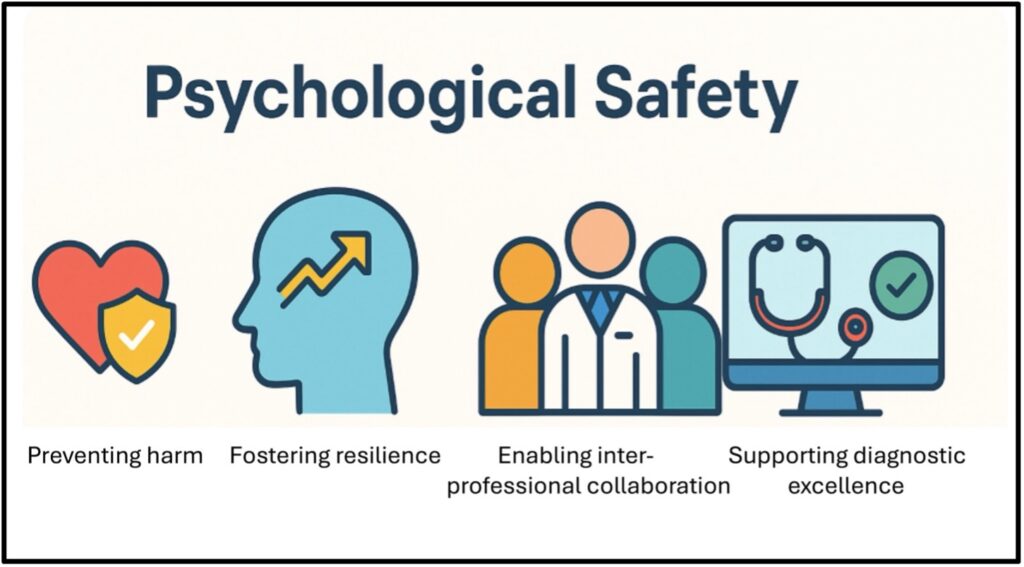
The purpose of this short essay, however, is not to focus on organizational environments, the value of teamwork, or how to cultivate specific leadership skills. My goal is to reflect for a moment on why health care providers should help their patients feel psychologically safe during each encounter. By doing this, they can help prevent patient harm, foster patient resilience, enable interprofessional collaboration, and support diagnostic excellence.

When patients feel psychologically safe, they communicate openly. They are more likely to disclose sensitive information about their medical history, symptoms, and behaviors without the fear of being judged or reprimanded. They are more likely to share results of their own research about their illness, and perhaps, view health care providers more as partners and advocates than authoritative decision-makers. Such engagement is essential to patient-centered care, which focuses on understanding and meeting patient needs and preferences. It is a significant part of the World Health Organization’s 2021-2030 Global Patient Safety Action Plan to eliminate avoidable harm in health care. 

In my experience, actions of unconditional acceptance accompanied by empathy and/or compassion also contribute to psychological safety and create an atmosphere that fosters resilience and greater patient well-being. As a “third party” other than family and friends, health care providers have a unique opportunity to affect, hopefully positively, the physical, mental, and emotional health of their patients. This includes engendering feelings of hope and optimism. Each patient-provider encounter, therefore, is potentially life-changing for the injured or ill person. By initiating or reinforcing their patient’s resilience, health care providers alter the patient-illness dynamic and contribute even more to their patient’s comfort, happiness, and sense of security.

It goes without saying that patients who feel psychologically safe are more likely to trust their health care provider’s attitudes and recommendations. They might see themselves more as active participants in decision-making processes, and as true partners in a multidisciplinary team approach to combat, control, or accept their state of health. In a psychologically safe environment, clinicians, patients, and their families can explore diagnostic or prognostic uncertainty with less trepidation, revisit initial hypotheses when clinical, laboratory, or imaging data conflict, and approach second opinions or further subspecialty referrals with greater confidence. Psychological safety thus contributes positively to interprofessional collaboration and the quest for diagnostic excellence.

Actions that help generate an environment in which patients feel psychologically safe are essential to optimizing the effects of each patient encounter with health care providers. They are separate from the organizational or systems-based changes necessary to build a psychologically safe culture for a health care facility’s physicians, students, administrators, and other employees. Because they are personal and often private, they connect the internal morality of medicine with the complex yet fragile operational realities of health care delivery. 

  1. Kumar, Santhi. Psychological Safety. CHEST, 2024. Volume 165, Issue 4, 942 – 949.
  2. Edmondson AC and Lei Z. Annu. Rev. Organ. Psychol. Organ. Behav. 2014. 1:23–43
  3. Global Patient Safety Action Plan. https://www.who.int/teams/integrated-health-services/patient-safety/policy/global-patient-safety-action-plan; 2021-2030. Accessed October 30, 2025.
  4. Fukami T. Patient engagement with psychological safety. Dialogues Health. 2023 Sep 17;3:100153. doi: 10.1016/j.dialog.2023.100153. PMID: 38515810; PMCID: PMC10953965.

Diane Keaton and altruism in the movies

trailer image of movie Marvin's room  and film with Diane Keaton about altruism


Diane Keaton passed away on October 11, 2025. She was seventy-nine years old. Versatile and classy, she defined the roles she was given rather than letting those roles define her. During a fifty-five-year movie career that included one Academy Award (in Woody Allen’s Annie Hall, 1977) and numerous star-billings alongside male movie greats such as Al Pacino, Jack Nicholson, and Warren Beatty, Ms. Keaton, through all her complex characterizations of femininity on screen, both dramatic and comedic, made a significant mark on American cinema.

In one of her lesser-known films, Marvin’s Room (directed by Jerry Zaks from a screenplay by Scott McPherson), she portrays Bessie, a staunch and self-sacrificing woman who has spent the last twenty years caring for her mute, bedridden, multiple-stroke victim father, Marvin (Hume Cronyn), and her ailing aunt, Ruth (Gwen Verdon). Bessie’s life changes drastically when she learns she has leukemia and requires a bone marrow transplant. The rest of the film is a poignant exploration of family dynamics, responsibility, and the value of selfless caregiving in the context of renewed relationships Bessie establishes with her estranged sister, Lee (Meryl Streep) and Lee’s two dysfunctional children, the emotionally volatile teenager, Hank (Leonardo DiCaprio) and his ten-year-old brother, Charlie (Hal Scardino), all of whom may be eligible donors for a procedure that could save Bessie’s life. 

The film draws attention to the high emotional toll of individual altruism rooted in a sense of duty, family responsibility, and unselfish love displayed by family caregivers. Today, and for the foreseeable future, many medical conditions that were once fatal are survivable. An increasing number of people, therefore, find themselves taking on the usually unpaid, self-sacrificial roles of caring for sick or disabled relatives. Results from a recent study in the United States, for example, showed that more than 59 million Americans provide care for an adult with a complex medical condition or disability, and another 4 million adult family members care for a sick or disabled child. In the United States, despite help from job-protective legislation such as The Family and Medical Leave Act (which provides twelve weeks of unpaid leave, continued health benefits, and guaranteed job reinstatement for those working in companies with more than fifty employees), these responsibilities render caregivers extremely vulnerable to unemployment, job and opportunity loss, financial hardships, emotional burnout, and physical illness.

In Marvin’s Room, as in real life, altruism cycles back as Bessie, the self-designated family caregiver, becomes the person in need. In addition to dealing with her own severe illness and the consequences of her new vulnerabilities, she must struggle with the problem of who will replace her if or when she is no longer able to provide caregiving services to her loved ones. Sadly, this reversal of fortune is not uncommon. Yet, the realities of caregiving environments are rarely the focus of medical or surgical consultations, which understandably target disease diagnosis and treatment.

Not all patients have a champion who can knowledgeably advocate for their well-being. Films like Marvin’s Room are a gentle reminder that it is a moral obligation and professional duty for physicians and other health care providers to take it upon themselves to inquire about caregiving responsibilities for all patients, and, if possible, to offer support, assistance, and tangible solutions that might help family caregivers lessen their burdens. In so doing, health care providers not only demonstrate compassion, selflessness, and commitment, they also create opportunities for acts of medical altruism that express our humanity.

Medical Altruism: It’s not simple

Doctors demonstrating medical altruism


The concept of medical altruism, which is central to health care delivery and both patient and physician well-being, is extraordinarily complex. Filled with nuance and interconnected layers, even its definition is problematic. Usually understood as a dynamic, context-dependent virtue, medical altruism can be viewed as a commitment by medical providers (physicians, nurses, and other providers) to use their power, position, privilege, and knowledge in the best interests of others (their patients) even at personal cost and varying degrees of effacement of self-interest. Seen in this light, medical altruism includes in its essence altruism (“other-regarding,” as coined by nineteenth-century French philosopher August Comte), and the morally obligatory trait of altruistic beneficence (as described by American ethicists Edmund Pellegrino and David Thomasma), which goes beyond the principles of benevolence (wishing others well) and nonmaleficence (not doing others harm).  

Regardless of whether medical altruism is approached from a philosophical, psychological, theological, evolutionary, professional, or cultural perspective, it must be distinguished from the concept of altruism in medicine. While medical altruism is individual and profession-centered, altruism in medicine is viewed as a commitment of the health care collective, including its professional organizations, institutions, economics, sociocultural environment, populations, and political systems to address healthcare based on altruistic rather than egoistic or self-centered values. Altruism in medicine, therefore, might also apply to selfless patient-originated decisions to donate blood, stem cells, organs, and other tissues, as well as healthcare provider-originated decisions to volunteer for humanitarian activities, combat global inequities, or share knowledge, time, and experience in degrees that are above and beyond what is expected of their professional duties and, in the case of physicians, their social contract with society. 

Further complicating discussions of medical altruism and altruism in medicine is the rapidly changing face of medical practice and health care environments. There are obvious tensions regarding the value and sustainability of selfless motivation, just as there are significant vulnerabilities and systemic weaknesses of existing health care institution-based frameworks and societal policies regarding professionalism and what constitutes ethical medical practice in a technology-driven, soon to be AI-dominated twenty-first century. These and other elements relating to altruism will be the focus of several future reflections on Colt’s Corner. Please subscribe and share.

  • Pellegrino, ED and Thomasma DC. The virtues of medical practice. Oxford University Press, 1993.
  • Creuss SR and Creuss RL. Professionalism and Medicine’s social contract with society. Virtual Mentor 2004;6(4):185-188.

Are you a Hedgehog or a Fox?

Hedgehogs and foxes sho general versus specialist knowledge


The philosopher Isaiah Berlin structured one of his most famous essays about the literary masterpiece, War and Peace, by Russian author Leo Tolstoy, on a quote from the Greek poet Archilochus (640-685 BCE): “The fox knows many things, but the hedgehog knows one big thing.” Berlin essentially described a dichotomy of thought, practice, and philosophy, contrasting “hedgehogs,” who might view the world through a single unifying idea, and “foxes,” who thrive on adaptability and their breadth of knowledge and experience. 

Berlin argued that Tolstoy, like Shakespeare, Pushkin, and Michel de Montaigne, was a fox who drew on history and experience in formulating his vision of life, but ultimately wished he could be a hedgehog, who, like Plato, Dante, or Dostoyevsky, could view the world through the lens of a single overriding idea. Berlin succeeded in presenting these two very different and opposable approaches to life without favoring one over the other. 

Since its publication in 1951, however, philosophers, psychologists, business professionals, educators, political leaders, and scientists have ferociously debated the metaphor of the hedgehog and the fox. For example, just a few years ago, author David Epstein reflected on differences between hedgehogs and foxes in his best-selling book, Range: why generalists triumph in a specialist’s world, writing that hedgehogs (specialists) “tend to see simple, deterministic rules of cause and effect framed by their area of expertise…whereas “foxes (generalists) understand that most cause-and-effect relationships are probabilistic, not deterministic,” arguing the benefits of breadth and diverse experience in a world that incentivizes hyperspecialization. 

Medical education, and much of medical practice, is at a crossroads regarding the contrast between specialists and generalists. The fox-like health care provider values breadth, adaptability, and creative problem-solving. Applied to medical education, the fox embodies the need for diverse strands of knowledge, interdisciplinary collaboration, systems thinking, synthesis, and integrating humanities training into medical curricula. The hedgehog approach, however, has dominated traditional medical training to cultivate depth of knowledge, expertise, technical skill, and precise systematic thinking within a well-defined framework to understand and competently manage disease processes.

In my opinion, our challenge is to cultivate “hedgehogs who can think like foxes.” Ambiguity and doubt must not be viewed as weaknesses but as manifestations of our humanity. While alternate ways of thinking about pathophysiology, diagnosis, therapeutics, technology, and scientific discovery must always be considered, a firm and concise direction for each must ultimately be chosen, especially in fields where results are quantifiable and judged on evidence-based results.  

Our goal, therefore, is to be deeply grounded in scientific knowledge and understanding as well as to be both rigorous and flexible in thought and medical practice. Knowing the general distinction between hedgehogs and foxes, and recognizing which of these two approaches we align with most naturally during our lifelong journey through a rapidly evolving medical landscape, is an essential step to greater self-awareness.

  • Isaiah Berlin. The Hedgehog and the Fox: An essay on Tolstoy’s View of History. OceanofPDF.com., Princeton University Press. First published, 1951.
  • David Epstein. Range: Why generalists triumph in a specialized world. Riverhead books. New York, 2019.

Introducing the new BronchAtlas

BronchAtas logo for new web-based educational program for bronchoscopy


Better lung health is within reach with our tailored solutions. Visit bronchatlas.com to find out how to
enhance respiratory care effectively.       https://bronchatlas.com

Our mission at Bronchoscopy International has always been and still is to provide practitioners and trainees around the world with free, easily accessible tools that will enhance their ability to care for their patients competently. Our slide decks have been used by teachers and learners for more than twenty years, and materials from The Essential Bronchoscopist series of training manuals are used in educational programs around the world, as well as by individual practitioners as study guides. Our Checklists and assessment tools have helped change the paradigm of procedure-related training, successfully complementing the traditional apprentice-style mode of professional development and facilitating competency-oriented training for new procedures. I am proud to say that our study guides were the first ever provided freely to bronchoscopists and interventional pulmonologists around the world, and our teaching videos, many created long before the video teaching boom, have had almost two million views.

With the new and improved BronchAtlas, our goal is to bring bronchoscopy-related learning to the bedside using an easily accessible and practical telephone-based learning instrument. This modality is a vital tool that requires minimal technology and works around varying levels of infrastructure. It is one more step in the direction of democratization of knowledge, an essential step toward greater professional development and improving patient outcomes.

With BronchAtlas (connect to www.bronchatlas.com), health care providers, students, as well as patients can easily access information pertaining to bronchoscopy in special situations. Each “topic” is covered by a series of bullet points organized into FOUR easily read components: addressing the problem at hand, providing the solution, listing a set of references, and providing links to an instructive YouTube-based video from our Bronchoscopy Academy YouTube channel. It takes less than three minutes to view each topic, making this tool ideal as a refresher or handy problem-solver. 

We hope you will enjoy using BronchAtlas, and we encourage you to pass the link to the BronchAtlas website along to your friends and colleagues. More “modules” are coming, so please let us know which other topics you would like to see addressed. Also, if you would like to assist with authorship or as a video contributor, please contact us. We look forward to hearing from you!

From Novice to Expert: The Dreyfus Skill Model

Dreyfus educational skill model with its six components


The Dreyfus model of skill acquisition was proposed in 1980 and has since been used by educators to explain how learners progress from being novices to becoming experts, passing through stages of being an advanced beginner, competent, and proficient at their assigned task. The authors later added a sixth stage, that of master, to their sequential and somewhat linear progression scale. 

The model is intuitively logical and appears to apply to most professional learning endeavors. It suggests that as learners progress, they move from strictly applying rules and guidelines to becoming aware of how their actions might affect and be affected by circumstances and their environment. This “intuitive perspective,” once acquired, is an important aspect of competence. With further work, training, and experience, learners develop what is referred to as “reflexive reorientation,” whereby learners are able to competently respond to changing or unexpected situations without necessarily resorting to reflective decision-making. For the most part, this defines the “expert” level of skill development.

The question is whether the Dreyfus model lends itself clearly to learning interventional pulmonology. Considering how the model stresses the importance of rules, guidelines, and intuitive experience-based decision-making, it helps educators design competency-oriented curricula and develop step-by-step knowledge and skills-related learning and testing materials. It underscores the importance of experiential knowledge and thus reinforces the complementarity of apprentice-style training with simulation-based learning.

The drawbacks, especially as regards bronchoscopy and interventional pulmonology, are based on the fact that one can reside simultaneously in different stages for different procedures, all while being perceived as an expert overall based on certification, place of practice, presumed experience, or academic titles. Furthermore, the boundaries between stages are blurred, and one may progress, regress, plateau, or skip stages depending on clinical context, the degree of technical difficulty of the procedure, or the complexity of the patient’s circumstances and medical environment. By no means, therefore, is there a linear progression universally applicable to all aspects of IP. 

Considering these limitations, I wonder whether a limited certification process could be helpful for certain groups of procedures. Obviously, competency-oriented learning materials for each group would address technical, cognitive, affective, and experiential knowledge, complemented by a series of associated assessment tools, simulation-based exercises, and real-life training experiences that help determine competency and level of expertise. 

The model also fails to consider individual learning differences, cultural variances, or the importance of having access to experts and masters for guidance and assistance. It ignores differences in experiential training, personality, and decision-making skills that might empower or endanger the effects of intuitive thinking and reflective reorientation, or reinforce personal biases that might hinder rather than promote professional and personal growth. I believe these elements become especially important for those aspiring to practice at the expert level.