Tag Archives: Medical education

Communication in Health Care: Patients and Providers

Effective communication in healthcare

 Communication in health care relies on a foundation of trust and psychological safety amid unexamined assumptions, non-dits (which is French for things left unsaid), potentially mismatched expectations, asymmetries of knowledge and power, vulnerability, unspoken emotional defenses, and differences in understanding or health care literacy. Perhaps this is why effective communication requires more than clarity of language. It also requires our attention to meaning, context, and subjective experiences, including the “emotional baggage” carried by all those involved in our conversations.

Whenever we communicate, we receive, transmit, and interpret both information and feelings. Psychological research shows that effective communication in health care is tied to perceived empathy, narrative coherence, and opportunities for all involved parties to be heard. Taking the time to sit at the patient’s bedside and avoiding potential distractions such as phone calls, computer screens, or unnecessary interruptions can be key to establishing rapport. In my experience, providers operating under time constraints, emotional strain, or institutional pressures have difficulty recognizing how fear, hope, and struggles tackling ambiguity or uncertainty adversely affect their patients’ understanding. They risk using technical jargon, matter-of-fact approaches, or paternalistic attitudes to rush through a conversation, disregard differences in health care literacy, or achieve a specific desired outcome. Hence, health care providers might subconsciously or intentionally distance themselves emotionally from their patients. The result is a potential undermining of a patient’s trust. Consequently, both caring and compassion are sacrificed on the altar of efficiency.  

Interprofessional communication between physicians, nurses, technicians, and allied health professionals also has its challenges. Healthy dialogue means overcoming real and perceived hierarchical barriers and role ambiguities. It means negotiating intergenerational differences, acknowledging differing professional identities grounded in diverse yet strangely singular training paradigms, and recognizing inward disengagement even when outward appearances signal agreement or a willingness to comply.

Overall, this introduces yet another layer of complexity to effective communication. Cultural expectations can vary significantly among trainees, mid-career professionals, and more senior practitioners. Intergenerational differences of opinion might exist regarding what constitutes competence and professionalism, for example, or how to communicate with respect to cultural diversity. Not everyone has similar views on the appropriateness of multitasking (it took me a while to realize that young people can remember and reflect on what I say even while scrolling through pictures and texts on their mobile phones), or on when to rely on narrative versus factual reasoning. 

Much more can be said about communication in health care. In future essays, I will briefly address dialogue between health care providers and administrators, conversations with patients’ families, and the challenge of effective communication with staff, other team members, and direct reports. I will also discuss communication failures and why I believe the observation and improvement of communication skills should be an integral part of competency—based training.  

Maleficence in Healthcare

Shows doctors and examples of intentional and unintentional maleficence


Maleficence in healthcare refers to any intentional and unintentional harm caused by healthcare providers or health systems. It is usually discussed in contrast to nonmaleficence, the avoidance of causing harm, one of the pillars of the Four Principles approach to medical ethics proposed by Beauchamp and Childress in the 1970s.

Intentional maleficence manifests as deliberate actions that knowingly harm patients. Thankfully, it is rare, and acts of intentional hurt, deception, exploitation, or fraud are universally frowned upon by health care providers, professional organizations, institutions, and society at large. Any intentional infliction of harm obviously betrays patient trust, which is the foundation of all physician-patient relationships.

Some of the most notorious examples of intentional maleficence stem from authoritarian regimes or times of military conflict. Acts ascribed to Nazi healthcare providers before and during World War II are among those most frequently cited. Forced euthanasia, the deliberate killing of populations considered unworthy of life, forced sterilization programs, and harmful experimentation in the name of science (such as cold-water immersion, intentional injection, or exposure to knowingly toxic substances, etc.) illustrate how Nazi doctors, midwives, nurses, and technicians intentionally murdered, tortured, or abused patients and other victims of the repressive Nazi regime. 

Other flagrant examples of intentional maleficence occurred during Argentina’s brutal military dictatorship (1976-1983). During this time, some health care providers were complicit in the torture or murder of innocent victims detained by state agents. This included documenting false causes of death (such as falls from high places), administering drugs to torture victims, and falsifying records used to facilitate unlawful adoptions of disappeared children. 

Equally disturbing are discoveries made during and after the Second Gulf War (2003-2011). Health care providers pressured by Saddam Hussein’s oppressive Ba’ath regime allegedly falsified death certificates and misrepresented legal reports of torture. Also troubling are reports that psychologists and United States military personnel failed to report human rights abuses of detainees undergoing interrogations at Abu Ghraib and Guantanamo Bay. 

Of course, cases of intentional maleficence are not limited to health care delivery under authoritarian or military regimes. Other examples include unethical human experimentation, the deliberate withholding of treatment (the 40-year Untreated Syphilis Study at Tuskegee comes to mind), performing unnecessary procedures regardless of context, economic misconduct and fraudulent practices to satisfy scientific, personal, or financial ambitions, and ideologically-driven care that disregards patient welfare in favor of personal gain or adherence to doctrinal beliefs and political policies.

*

While intentional maleficence is a clear violation of professional ethics and fiduciary duty, the picture is less clear in cases of unintentional maleficence, which is both more prevalent and ethically complex. Unintentional maleficence usually stems from cognitive and experiential bias, system pressures, fragmented care, miscommunication, a propensity to practice medicine defensively, clinical uncertainty, or unwarranted therapeutic zeal. It can also be an unfortunate and even deadly result of medical error, negligence or professional incompetence.

Unintentional maleficence often occurs despite well-intentioned practices. In these cases, ethical analysis is challenging because health care providers usually act in the pursuit of beneficence. A prime example is any medical intervention for which possibilities for an undesired outcome are underestimated or not revealed. High-risk treatments, polypharmacy in vulnerable populations, and technically correct but ethically damaging decisions are other instances where harm may occur despite a health care provider’s intention to help. A well-known illustration is “the double effect,” in which a medical intervention has two causally independent outcomes: one that is ethically and legally acceptable, such as the relief of pain or anxiety, and another that is not, such as a patient’s death from oversedation.

Maleficence in healthcare includes both intentional and unintentional harm caused by clinicians or systems, raising complex ethical challenges that go beyond nonmaleficence. In my opinion, more conversations about these topics are warranted within the Interventional Pulmonology community. This is because maleficence encompasses both intentional and unintentional harms arising from clinical actions, flawed decision-making, or omission. These may result in ethical violations, poor patient outcomes, and ideological harm. Health care providers, institutions, and professional societies are morally accountable to design systems that minimize foreseeable harm and respond proactively to sentinel events. They should create and support conditions that prioritize patient safety, transparency, overall well-being, and ethical awareness over convenience, personal gain, or professional protectionism.

  • Beauchamp TL and Childress JF (2019). Principles of Biomedical Ethics (8th ed). Oxford University Press.
  • Beecher HK. Ethics and Clinical Research. N Engl J Med 1966;274:1354-1360.
  • Weindling PJ (2004). Nazi Medicine and Nuremberg Trials. Palgrave Macmillan.
  • Reis C, Ahmed AT, Amowitz LL, et al. Physician Participation in Human Rights Abuses in Southern Iraq. JAMA. 2004;291(12):1480–1486. doi:10.1001/jama.291.12.1480.
  • Scheper-Hughes, N. The Ghosts of Montes de Oca: Buried Subtext of Argentina’s Dirty War.” The Americas2015;72(2):187-220. Project MUSEhttps://muse.jhu.edu/article/579738.
  • Newly unredacted report confirms psychologists supported illegal interrogations in Iraq and Afghanistan. ACLU Release, April 30, 2008. https://www.aclu.org/press-releases/newly-unredacted-report-confirms-psychologists-supported-illegal-interrogations-iraq.

Beneficence, Benevolence, and the Act of Doing Good

Woman holding heart benevolently to elderly woman with cane. Benevolence and good intentions


More than two thousand years ago, the Hippocratic Corpus (5th century BCE) fostered principles of beneficence, non-maleficence, confidentiality, and accountability to help guide physician practices and behaviorsThese ideals were later embraced by Christian, Jewish, and Islamic ethical traditions from the Middle Ages through the Enlightenment. In 7th century China, Sun Simiao emphasized compassion, selfless dedication, and duty in his important work, On the Absolute Sincerity of Great Physicians, while Buddhist traditions, coexisting with ancient Confucianism, valued generosity (dāna) and the precept of non-injury. Across cultures and eras, medical ethics has thus joined duty with virtue, blending obligation and character to help define good medical practice.  

In contemporary healthcare ethics, beneficence is described as actions and rules aimed at benefiting others, helping them further their legitimate interests and preventing or removing potential harms. It is usually viewed as a moral obligation or duty rooted in professional responsibility. It defines what one ought to do in a particular situation, whether to improve patient welfare, protect life, or pursue specifically desired health-related outcomes.

Benevolence, by contrast, describes a disposition, not an obligation. The Oxford Dictionary of Philosophy defines it as the “general desire for the good of others, and a disposition to act so as to further that good.” While benevolence derives from the principle of beneficence, it is a moral virtue equated with charity, kindness, and generosity. As such, it can be distinguished from beneficence in that it is grounded in goodwill toward patients rather than in professional duty. While beneficence concerns right action, benevolence concerns right intention—and the two, though often aligned, are not identical.

This distinction becomes evident in clinical practice. For example, a physician may act beneficently toward a patient because of their sense of duty, even when the patient is abusive, dangerous, or requesting medical aid in situations that conflict with the physician’s personal values. In such cases, a doctor’s intrinsic desire “to do good” for their patient may be lacking, yet they may still act rightly and in accordance with professional standards. 

Benevolence, however, explains actions of a different type. Grounded in the humanity of health care providers, it reflects a physician’s disposition toward goodwill rather than obligation. It may motivate behaviors that are ultimately detrimental to a patient’s well-being when unchecked by professional or ethical norms. It may also explain why some providers undertake actions that are heroic or go beyond those required by duty. In the extreme, these may involve extraordinary personal sacrifice to aid vulnerable patients. 

In the end, the practice of medicine is judged not only by outcomes and rules, but by intention. Beneficence may compel right action in the right circumstances, while benevolence often reveals the moral character—the right reasons—from which care emerges. Together, they affirm essential moral dimensions of ethical medical practice.

Dimensions of Medical Altruism

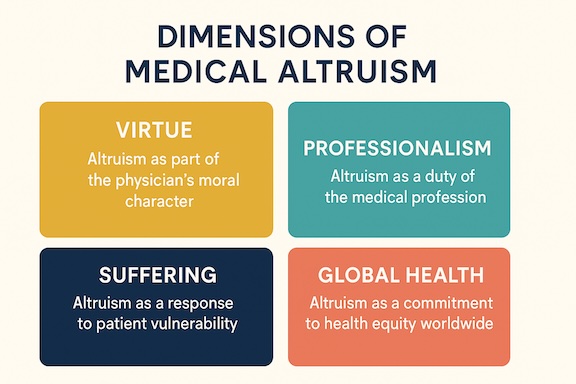
Medical altruism is virtue professionalism suffering and global health


Medical altruism is usually considered a virtue that is critical to defining a physician’s moral character. However, one of its more noticeable manifestations is behavioral, reflecting compassion, responsibility, and a sense of moral obligation. Indeed, medical altruism translates into a commitment by health care providers to use their power, position, privilege, and knowledge in the best interests of others, even at great personal cost and varying degrees of effacement of self-interest. Therefore, medical altruism represents physicians’ spoken and often unspoken commitment to act selflessly for their patients’ well-being, regardless of potentially conflicting professional duties, even at the expense of personal gain, safety, or well-being.

American philosophers Pellegrino and Thomasma thus argued that beneficent altruism was morally obligatory for physicians, placing it at the root of a “virtuous” physician’s character. “No one can make the conscientious professional do what she thinks is not in the interests of the patient or client,” they write, and “The physician of character will…reliably be expected to exhibit the virtues of fidelity to trust and effacement of self-interest.”

Other manifestations of medical altruism might have their roots in a person’s psychological profile. In part, this is because medical altruism is almost always viewed as being individual-centered, and therefore, potentially at the core of a physician’s personal identity. For example, some physicians’ altruistic behaviors are linked to their heartfelt desire to relieve suffering. This is reflected by physician and bioethicist Eric Cassell’s (1928-2021) belief that “The relief of suffering and the cure of disease must be seen as twin obligations of a medical profession that is truly dedicated to the care of the sick.”  Dr. Cassell viewed suffering as a primarily subjective experience, describing it as “the state of severe distress associated with events that threaten the intactness of the person.”

A slightly different perspective was presented by Daniel Sulmasy, who is well known for his writings about the connection between spirituality and medicine.  He argued to reaffirm Sir William Osler’s declaration that medicine was a calling, not a business. Dr. Sulmasy is a physician and philosopher who once lived as a Franciscan friar. Focusing on a physician’s character, he suggests that altruism is a virtue easily threatened by a malfunctioning or flawed medico-industrial complex. He warns that unsound training environments and the stress/realities of day-to-day medical business practices can potentially erode altruistic ideals.

Richard and Sylvia Cruess argue that if medicine is a profession, then medical altruism is a professional duty. They believe altruism is at the core of the physician-patient contract and a centerpiece of the social contract between physicians and society: “Based on the literature, society’s expectations of medicine are the services of the healer, assured competence, altruistic service, morality and integrity, accountability, transparency, objective advice, and promotion of the public good.” According to this position, physicians have a professional obligation to engage in altruistic behaviors, the degrees of which can be hotly debated. Additionally, medical institutions and health care policies should promote and support altruism from a systems perspective because altruism is both expected and contractually anticipated by society-at-large.

This brief discussion of the various dimensions of medical altruism would be incomplete without acknowledging the work of recently defunct physician and anthropologist Paul Farmer (1959-2022). Dr. Farmer supported Article 25 of the Universal Declaration of Human Rights: “Everyone has the right to a standard of living adequate for the health and well-being of himself and his family, including food, clothing, housing, and medical care….” He expanded upon patient-focused boundaries of medical altruism by proposing that health care providers be individual caregivers but also advocates in the battle to overcome social inequalities.

  • Pellegrino, ED and Thomasma DC. The virtues of medical practice. Oxford University Press, 1993.
  • Cassell, E. J. 1982. “The Nature of Suffering and the Goals of Medicine.” N Engl J Med 306 (11): 639–45.
  • Sulmasy, Daniel P. (1993). What’s so special about medicine? Theoretical Medicine and Bioethics 14 (1):379-380.
  • Cruess SR. Professionalism and medicine’s social contract with society. Clin Orthop Relat Res. 2006 Aug; 449:170-6.
  • Farmer, P. Pathologies of power: Health, human rights, and the new war on the poor. University of California Press, 2003.

Introducing the new BronchAtlas

BronchAtas logo for new web-based educational program for bronchoscopy


Better lung health is within reach with our tailored solutions. Visit bronchatlas.com to find out how to
enhance respiratory care effectively.       https://bronchatlas.com

Our mission at Bronchoscopy International has always been and still is to provide practitioners and trainees around the world with free, easily accessible tools that will enhance their ability to care for their patients competently. Our slide decks have been used by teachers and learners for more than twenty years, and materials from The Essential Bronchoscopist series of training manuals are used in educational programs around the world, as well as by individual practitioners as study guides. Our Checklists and assessment tools have helped change the paradigm of procedure-related training, successfully complementing the traditional apprentice-style mode of professional development and facilitating competency-oriented training for new procedures. I am proud to say that our study guides were the first ever provided freely to bronchoscopists and interventional pulmonologists around the world, and our teaching videos, many created long before the video teaching boom, have had almost two million views.

With the new and improved BronchAtlas, our goal is to bring bronchoscopy-related learning to the bedside using an easily accessible and practical telephone-based learning instrument. This modality is a vital tool that requires minimal technology and works around varying levels of infrastructure. It is one more step in the direction of democratization of knowledge, an essential step toward greater professional development and improving patient outcomes.

With BronchAtlas (connect to www.bronchatlas.com), health care providers, students, as well as patients can easily access information pertaining to bronchoscopy in special situations. Each “topic” is covered by a series of bullet points organized into FOUR easily read components: addressing the problem at hand, providing the solution, listing a set of references, and providing links to an instructive YouTube-based video from our Bronchoscopy Academy YouTube channel. It takes less than three minutes to view each topic, making this tool ideal as a refresher or handy problem-solver. 

We hope you will enjoy using BronchAtlas, and we encourage you to pass the link to the BronchAtlas website along to your friends and colleagues. More “modules” are coming, so please let us know which other topics you would like to see addressed. Also, if you would like to assist with authorship or as a video contributor, please contact us. We look forward to hearing from you!

From Novice to Expert: The Dreyfus Skill Model

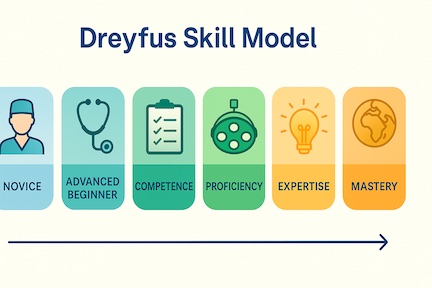
Dreyfus educational skill model with its six components


The Dreyfus model of skill acquisition was proposed in 1980 and has since been used by educators to explain how learners progress from being novices to becoming experts, passing through stages of being an advanced beginner, competent, and proficient at their assigned task. The authors later added a sixth stage, that of master, to their sequential and somewhat linear progression scale. 

The model is intuitively logical and appears to apply to most professional learning endeavors. It suggests that as learners progress, they move from strictly applying rules and guidelines to becoming aware of how their actions might affect and be affected by circumstances and their environment. This “intuitive perspective,” once acquired, is an important aspect of competence. With further work, training, and experience, learners develop what is referred to as “reflexive reorientation,” whereby learners are able to competently respond to changing or unexpected situations without necessarily resorting to reflective decision-making. For the most part, this defines the “expert” level of skill development.

The question is whether the Dreyfus model lends itself clearly to learning interventional pulmonology. Considering how the model stresses the importance of rules, guidelines, and intuitive experience-based decision-making, it helps educators design competency-oriented curricula and develop step-by-step knowledge and skills-related learning and testing materials. It underscores the importance of experiential knowledge and thus reinforces the complementarity of apprentice-style training with simulation-based learning.

The drawbacks, especially as regards bronchoscopy and interventional pulmonology, are based on the fact that one can reside simultaneously in different stages for different procedures, all while being perceived as an expert overall based on certification, place of practice, presumed experience, or academic titles. Furthermore, the boundaries between stages are blurred, and one may progress, regress, plateau, or skip stages depending on clinical context, the degree of technical difficulty of the procedure, or the complexity of the patient’s circumstances and medical environment. By no means, therefore, is there a linear progression universally applicable to all aspects of IP. 

Considering these limitations, I wonder whether a limited certification process could be helpful for certain groups of procedures. Obviously, competency-oriented learning materials for each group would address technical, cognitive, affective, and experiential knowledge, complemented by a series of associated assessment tools, simulation-based exercises, and real-life training experiences that help determine competency and level of expertise. 

The model also fails to consider individual learning differences, cultural variances, or the importance of having access to experts and masters for guidance and assistance. It ignores differences in experiential training, personality, and decision-making skills that might empower or endanger the effects of intuitive thinking and reflective reorientation, or reinforce personal biases that might hinder rather than promote professional and personal growth. I believe these elements become especially important for those aspiring to practice at the expert level. 

Ethics in Interventional Pulmonology

logo of ethics in interventional pulmonology a medical program


Ethics, from the Greek words ēthos and ēthike philosophia (moral philosophy), is traditionally defined as the study of morality. What ought I do in a particular situation? What are the limits of my responsibility? How do my actions and behaviors relate to the particular norms, expectations, rules, or codes of conduct established by my profession, peers, and society, and how might these affect my community? 

The study of ethics also raises awareness and helps address other questions: Do my actions reflect a moral conscience at the center of my being or a system of thought dependent upon religious or societal models of expected behaviors? What are the emotional consequences if I must choose, in my desire to do what is right, from among potentially opposing ethical concepts, and might I rely on both subjective and objective arguments to justify my decisions? 

The Greek philosopher, Aristotle (384-322 BCE), was himself the son of a physician. He begins his treatise, Nichomachean Ethics, by writing, “Every art and every inquiry, and similarly every action and pursuit, is thought to aim at some good…will not the knowledge of it, then, have a great influence on life?”[i] Since its origins, the ‘art and science’ of bronchology and interventional pulmonology has grown in leaps and bounds. Focus has been on disease states, procedural techniques, training curricula, and how to best apply new technologies. The study of IP-related medical ethics, however, has sadly been neglected, as if medical doctors felt naturally inclined to ethical practices because they went to medical school and wear white coats or surgical scrubs. By no means do I suggest that IP specialists practice unethically. In fact, all the practitioners I know do their best to provide appropriate and competent patient care based on existing scientific evidence and the resources they have available. The practice of interventional pulmonology does, however, raise a variety of ethical dilemmas for which doctors are not necessarily trained, and situations for which doctors may not be fully aware of potential ethical issues at hand.

Therefore, based on my own experience practicing medicine and surgery around the world in diverse settings, my formal training as a medical ethicist, educator, mediator, and philosopher, and my current work as a philosopher practitioner, I decided to add an Ethics section to the Bronchoscopy International website at www.bronchoscopy.org. I have also prepared a first volume (available for free download in PDF form), Introduction to Ethics in Flexible Bronchoscopy, to serve as an introductory text for practitioners and IP specialists in training. My goal is to provide readers with fundamentals from which they may gain perspective to discuss, evaluate, reflect upon, and more readily address ethical issues faced in their daily practice of interventional pulmonology. My hope is to see ethics discussed in yearly training courses, national meetings, and IP societies’ international conferences. I welcome your feedback and hope this text is a helpful addition to other educational materials used by our profession.


[i] The Basic Works of Aristotle. Eds Richard McKeon. The Modern Library, Random House, NY, 2001. Nichomachian Ethics, book I, 1094a. WD Ross trans.

Seven Learning Styles and Artificial Intelligence 


It is common sense that everyone learns differently, and that teachers should do their best to use a variety of methods to transfer knowledge from themselves to their students. Of course, we also want learners to do more than solve problems they have seen before. This means that we want them to be able to apply whatever they have learned to solving new problems in novel settings. This also means we want them to acquire what psychologist William James referred to as “an inventive mind.”

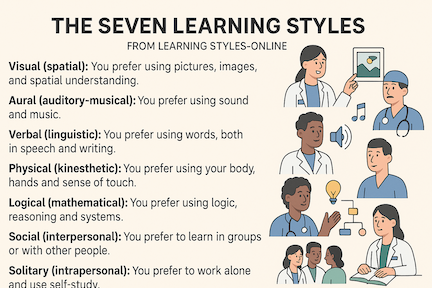
Artificial Intelligence (AI) is favorably impacting this environment because it empowers learners. It offers them a variety of tools so they may embark on “learning paths” that best suit their individual natural preferences and particular customizable circumstances. Whether it be from the elaboration of interactive diagrams, engaging with chatbots, receiving instant feedback, or listening to individually-tailored audio lessons, for example, AI promotes learning according to Visual, Auditory, and Verbal styles. By interacting in a digital space or AI-driven simulation, using algorithm-based tutors that evolve as individuals progress, and collaborating with others through smart platforms, people who benefit most from physical, logical, and social styles can also expand their means for learning. And let’s not forget that AI promotes independent study by offering learners an opportunity to formulate a series of increasingly complex or deep-rooted queries simply by repeated interactions with programs such as ChatGPT, Claude, or Gemini (and others).

So, what does this mean for bronchoscopists and interventional pulmonologists? It means we must rethink the way we organize educational programs, on-site or remotely-delivered lectures, conferences, and even hands-on workshops. It probably means increased emphasis on a learning by doing methodology, or what the philosopher John Dewey referred to as “activity methods,” at the bedside, in the classroom and procedure suite, as well as in the conference hall. The transition will come naturally for a new generation of learners and teachers but may pose a significant challenge for old-schoolers and those inclined to be resistant to change.

Real-time Procedure Numbers are Important


Interventional pulmonology entails procedural expertise in a number of conventional and evolving medical procedures. The number of procedural modalities are increasing, however, as is their complexity. In addition to their traditional apprenticeship training, IP specialists use simulators and attend on-site multi-day training courses. These are invaluable for acquiring training for specific procedures, emergencies, and technical skills, but procedural numbers, actually learning by doing in the clinical setting, help develop the judgment, resilience, and nuance that only real-world experience can provide.

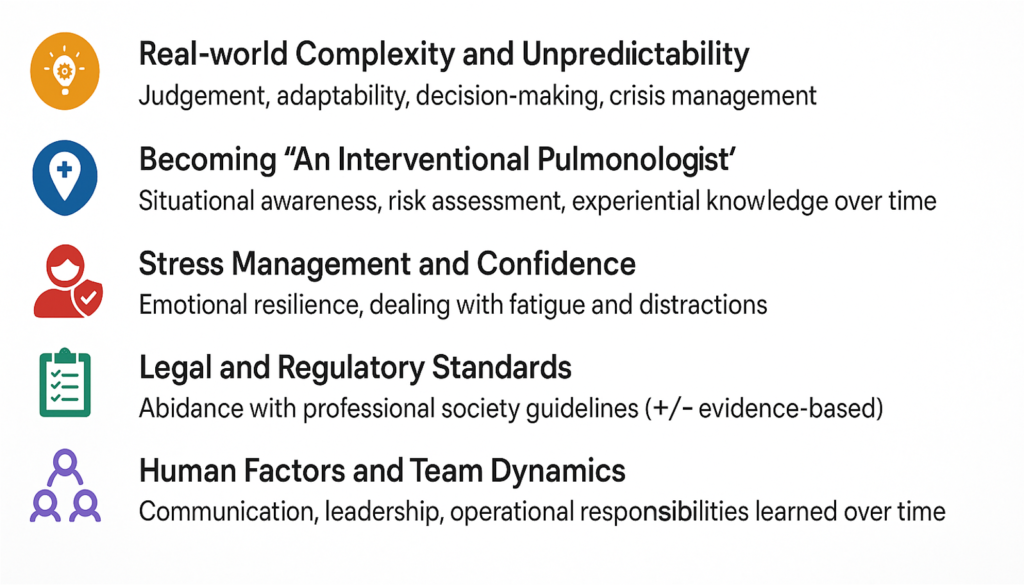
Real-time procedural numbers are critical because they represent real-world complexity and unpredictability crucial to learning good decision-making and crisis management. They are important to becoming an “interventional pulmonologist” because situational awareness and experiential knowledge grow over time. They teach stress management and enhance an operator’s confidence. They also abide with legal and regulatory standards, even if these are not yet evidence-based. Finally real-time procedural numbers are crucial to learning communication, leadership, and team-building skills that are applicable in an ever-changing real-world medical environment.  

Considering the growing number of IP specialists seeking training, however, institutions are increasingly challenged with finding enough patients to fill the “procedural demand,” and it is uncertain whether all training institutions can honor procedural numbers criteria listed in the specialty’s various guidelines. Finding a satisfactory and ethical solution to this problem is a task the specialty’s leaders must address…soon.

A Glimpse Towards the Future


The history of Interventional Pulmonology (IP) is marked by technological advances, progress in imaging and surgical techniques, the vision of a few key personalities, and the establishment of dozens of IP associations around the world. Important milestones were reached by resolving conflicts with various national and international pulmonary and thoracic surgery societies, and by reexamining the specialty’s self-defined goals and identity. 

Despite occasional differences of opinion and instances of competitive rather than collaborative professional interactions, the interventional pulmonology field remains unified by a shared commitment to improving the diagnosis, prevention, and treatment of patients with emerging, potentially life-threatening, or advanced lung, airway, and pleural disorders.

For over a century, generations of clinicians, researchers, industrial engineers, basic scientists, physicists, equipment manufacturers, and computer scientists have contributed to innovations aimed at meeting the growing demands for minimally invasive interventions and the challenges of a changing medical landscape. The ongoing pursuit for effective, targeted, and personalized quality patient care ensures that interventional pulmonology will continue to thrive as a dynamic, integrative, and transformative medico-surgical specialty.

However, the approach, scope, timing, and purpose of interventional pulmonology must respond to the needs of a growing population, shifting social and medical demographics, and the advancement of evolving technologies. It must also address challenges posed by an increasing diversity of care environment and a world struggling to overcome significant disparities in medical access, philosophies of care, economics, education, and collaboration.

I believe the future of interventional pulmonology hinges on five key elements, all equally important and inherently interconnected, much like the links in a bicycle chain. These are (1) Greater collaboration across borders for training and education; (2) A strategic shift from reactive to proactive patient care interventions; (3) Building environments that nurture courageous, unselfish, and visionary leadership; (4) Developing a global strategy to address issues of cost and accessibility; and (5) Supporting dreamers, pragmatists, teachers, and students in their quests for professional security in a world increasingly governed by artificial intelligence. IP societies should draft and publish papers addressing each of these elements in a concerted effort to build a foundational blueprint for the years ahead.